You know the feeling when you walk into a room and your shoulders drop.
Not because you’re tired. Because something in the space said: you can stop now. The light is soft. There’s nothing asking anything of you. Everything in the room feels like it was chosen — not accumulated.
That’s what a slow living home feels like. And it has nothing to do with how much money you spent on it.
It’s not a style. It’s a feeling.
Slow living at home isn’t about minimalism, or Japandi aesthetics, or having the right linen cushions. It’s about creating a space that supports the version of yourself you’re trying to become — the one who moves a little slower, breathes a little deeper, and doesn’t need the room to perform anything.
The question isn’t “does this look good?” It’s “does this feel like me?”
1. Let light do the work
Natural light changes throughout the day, and a slow living home pays attention to that. Instead of overhead lighting that flattens everything, try a single warm light source placed low — on a shelf, a bedside table, a corner of the floor.
Watch what it does to the room. The shadows it makes. The way it changes at dusk.
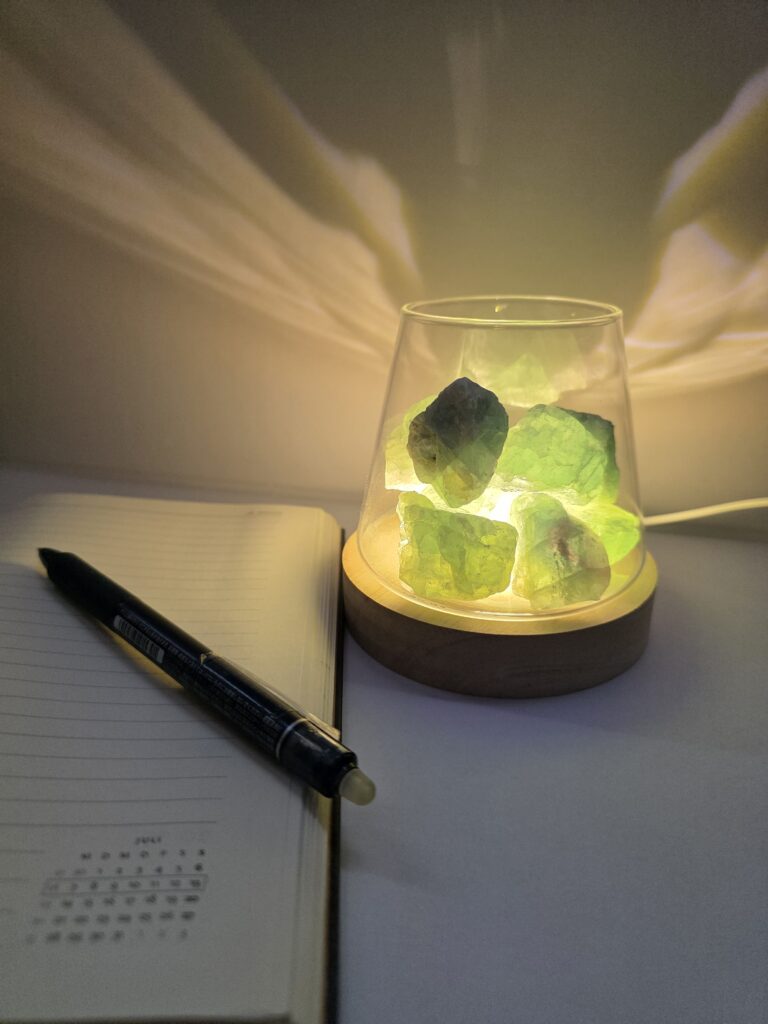
This is what we built Still. around — a lamp that doesn’t just illuminate, but creates. The jade lamp scatter the light in a way that’s never quite the same twice. It gives the room a quality that’s hard to name, but easy to feel.
2. Claim a corner that’s entirely yours
Not a “reading nook” from a design magazine. A corner that reflects exactly how you want to arrange things.
A small tray with objects that mean something to you. A stone you picked up somewhere. A book you haven’t finished. A candle you only light when you mean it.
The act of arranging these things — and keeping them arranged the way you want — is a quiet form of self-knowledge. You’re saying: this is what I value. This is how I want to live.
Nobody else has to understand it.
3. Bring in something that grew
A plant. Dried botanicals. A branch you found on a walk. Something that came from outside, that carries the logic of natural time rather than human time.
Living things remind you that growth is slow. That patience is structural, not optional.
4. Choose one natural material and let it age
Wood that develops a patina. Stone that holds the cold. Linen that softens with every wash.
Natural materials have memory. They change with you. They make a home feel inhabited rather than staged.
5. Remove one thing
Slow living homes are not empty. But they have space. Not just physical space — visual space. A place for the eye to rest.
Look around the room you’re in right now. What’s one thing that’s there out of habit, not intention? A slow living home is built one removal at a time.
You don’t need to redecorate. You need one corner, arranged the way you want it. One light source that makes the room feel quieter. One object that means something.
Start there. The rest follows.