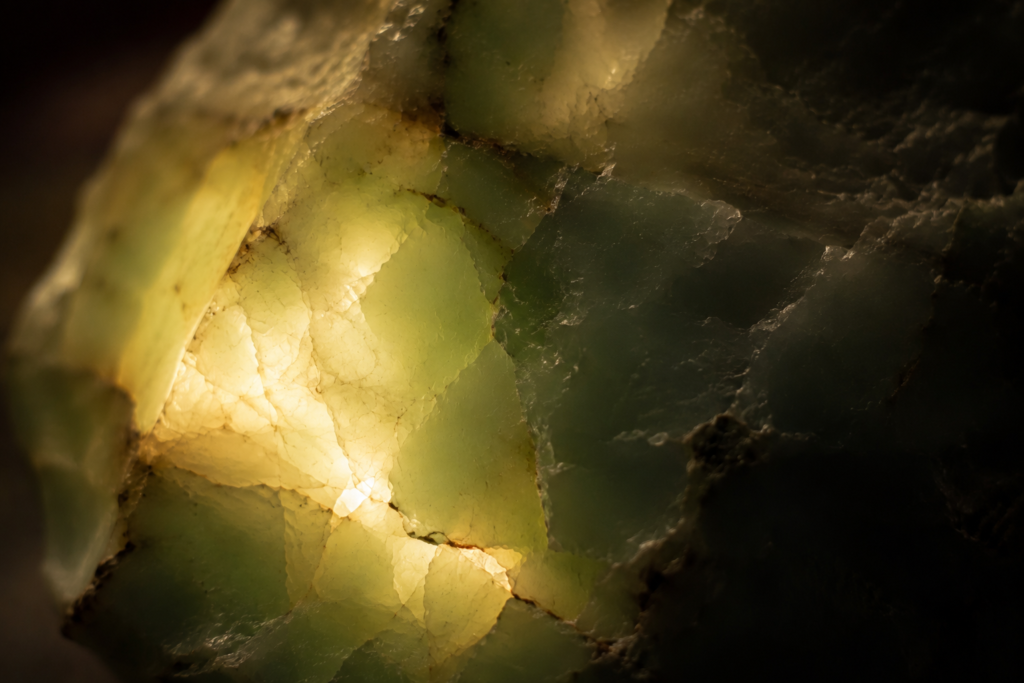
Two lamps can put out the same amount of light and feel nothing alike. Anyone who has swapped a warm bulb for a cool one knows this already — the room changes even though the furniture hasn’t moved. A jade lamp and a standard LED sit at opposite ends of that difference. Understanding why is partly about physics and partly about what light is doing to you when you are not thinking about it.
What an LED actually does
An LED produces light at a single point and sends it outward evenly. That is what it was designed to do. It is efficient, consistent, and bright, which is exactly what you want when you are chopping vegetables or reading a contract.
The evenness is the point, and also the limit. An LED gives you a flat, uniform field of light. Nothing about it varies across the surface. Your eye takes it in once and stops noticing it, the same way you stop hearing a fan running. It does its job and disappears.
For a workspace, that is ideal. For the last hour of the evening, it is the wrong tool. Even a “warm” LED is still a uniform source pretending to be soft. The color has changed but the character hasn’t.
What happens when light passes through stone
A jade lamp does not light a point. It lights a material, and the material gets in the way.
When the bulb sits behind real jade, the light has to travel through stone that is denser in some places than others. Some of it passes through easily. Some of it is absorbed. Some scatters sideways before it reaches your eye. The result is a glow that is uneven by nature — brighter where the stone is thin, darker where it is thick, shifting depending on where you are sitting.
This is the same reason firelight and candlelight feel different from a bulb. The light is not constant. It has texture. Your eye keeps finding small variations in it, and that low-level movement reads as calm rather than as something demanding attention.
You cannot fake this with an LED, because an LED has nothing to pass through. Uniform light stays uniform. The unevenness of a jade stone lamp comes from the stone being real, not from a setting.
Why the difference matters at night
There is a practical reason to care about this beyond preference.
Bright, even light tells your body it is still daytime. That is not a metaphor — the signal that regulates when you feel alert runs partly on light, and a flat overhead field is close to what the middle of the day looks like to your eyes. Keep that light on until you sleep and part of you stays switched on.
Low, uneven, warm light does the opposite. It is closer to what humans saw in the last hour before sleep for most of history: fire, embers, the sun almost gone.
The Danes have a word for this — hygge — and lighting sits at the center of it. Meik Wiking, who runs the Happiness Research Institute in Copenhagen, writes that the Danish emphasis is on soft light rather than harsh overhead sources — and points out that Denmark burns more candles per person than anywhere else in Europe. A jade lamp belongs to the same instinct: light chosen for how it feels, not how much it shows.
An LED can be dimmed, and a dimmed warm LED is genuinely better than an overhead light. But it is still a flat source. The jade lamp adds the one thing dimming cannot: variation.
When each one is right
None of this makes the LED wrong. It makes it a different tool.
Use an LED where you need to see clearly — the desk during work hours, the kitchen, anywhere the job is legibility. Trying to work by a jade lamp is a mistake in the other direction; it was never bright enough for that and pretending otherwise helps no one.
Use a jade lamp where the job is not seeing but settling. The nightstand. The reading chair after the laptop is closed. The corner where you sit and do nothing on purpose. If you are still deciding where yours would go, we wrote a separate guide on where a jade lamp belongs. In those places the uneven glow is not a limitation. It is the entire reason to have it.
Most homes need both. The mistake is using one light for every hour of the day, and then wondering why the evening never feels like it has started.
The short version
An LED gives you light. A jade stone lamp gives you light that has passed through something real, and the difference is the unevenness — the part your eye keeps noticing without knowing why. One is built to be seen by. The other is built to be sat with.
Light the quiet within.