Jade is one of the oldest stones to travel through human history. It has been carried in pockets, carved into ornaments, buried with kings, and placed beside newborns — across cultures that never met. What did all these cultures see in a single green stone? And why does jade stone meaning still matter today, in rooms that look nothing like the ones it first lived in?
This is a long read. Pour something warm. Let’s go slowly.
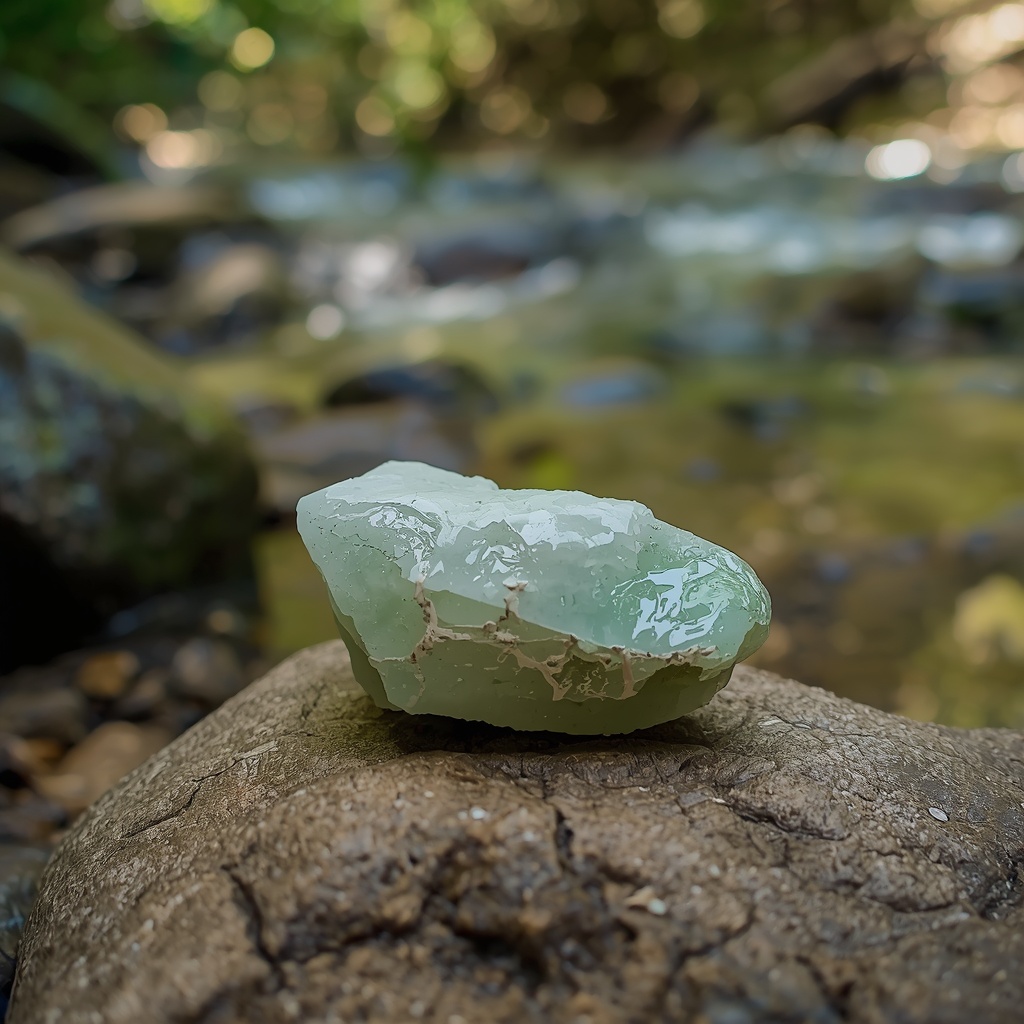
What Jade Actually Is
The word ‘jade’ refers to two different minerals: nephrite and jadeite. Nephrite is a calcium magnesium silicate, usually softer and milkier in color. Jadeite is a sodium aluminum silicate, harder and often more vibrant. To the naked eye, a polished piece of either can look nearly identical. Both have been used interchangeably as ‘jade’ throughout history.
Green is the color most associated with jade, but the stone occurs in white, lavender, yellow, black, and orange. Imperial jade — a deep, saturated green jadeite — has historically been the most prized. But green nephrite, the softer cousin, is the jade carried most commonly in everyday objects: pendants, bracelets, small carvings, and, more recently, lamps.
Jade in Ancient China
In China, jade has been worked for more than eight thousand years. Archaeologists have found carved jade in Neolithic tombs that pre-date writing. By the time written history began, jade was already a stone of status, ritual, and spiritual significance.
Confucius compared jade to virtue itself. He wrote that the stone was ‘soft and smooth and glossy like benevolence; fine and compact and strong like intelligence.’ In his framing, jade was not decorative. It was a physical expression of the qualities a good person should cultivate. Jade meaning, in this tradition, is internal: composure, fairness, moral steadiness.
Chinese emperors were buried in jade suits — thousands of small squares of stone stitched together with gold wire — in the belief that jade would preserve the body and protect the soul. Even today, small jade pendants are given to newborns for protection and luck.
Jade in the Americas
On the other side of the world, Mesoamerican cultures — Olmec, Maya, Aztec — prized jade even more highly than gold. For them, green jade was the color of water, of young corn, of life itself. Jade beads were placed in the mouths of the dead to accompany the soul. Kings wore jade masks. The material was so central that Aztec merchants would trade gold for jade without hesitation.
In Maori culture, in New Zealand, a green stone called pounamu — a type of nephrite — is considered sacred. It is passed between generations, carries the mana (spiritual energy) of its wearers, and is often gifted rather than sold. The Maori word for it, pounamu, is used in both spiritual and everyday contexts.
These cultures never exchanged notes. They arrived at the same conclusion independently. Jade stone meaning, across these traditions, points to the same thing: life, protection, and calm continuity.
Jade Meaning in Modern Practice
In modern crystal healing, jade is grouped with stones associated with the heart chakra and with emotional balance. Practitioners describe it as a grounding stone, one that supports steady mood and reduces reactivity. Whether or not you engage with the metaphysical framing, the physical experience of jade is consistent: cool, heavy, dense. It is a material that feels substantial in the hand.
Many people today place jade in their homes not because they expect literal energy, but because the stone is a visual and tactile anchor. A small jade object on a desk becomes a pause button. Touching it interrupts the momentum of a difficult moment. This is, in itself, a complete reason to live with jade.
Why Green Specifically?
Green is the color the human eye sees most easily. Our visual systems evolved in environments where green meant life — water, growth, safety. Rooms painted in soft green tones consistently test as more calming in psychological studies. Hospitals and waiting rooms use green walls on purpose.
Green jade combines the ancient symbolism with this basic perceptual fact. When you look at a glowing green jade lamp in a dim room, your nervous system is doing the same work it has been doing for millions of years: recognizing green as a sign that everything, for now, is alright.
How to Live With Jade
You do not need a ceremony. You do not need a lineage. You do not need to subscribe to any particular belief system. Jade stone meaning becomes yours the moment you choose to live with the stone.
A few practical suggestions:
- Place a piece of jade where you sit. The corner of a desk. The arm of a reading chair. A meditation cushion.
- Touch it once a day. Before a difficult meeting. After a difficult conversation. At the end of the workday.
- Give it as a gift. Jade has always traveled between people. A piece you give carries the moment you gave it.
- Use it as light. A natural jade stone lamp turns the stone into a daily ritual. You don’t have to remember to engage with it — simply turning on the light is enough.
Jade has been meaningful for thousands of years for the same reasons it can be meaningful today. The world moves. The stone does not. That is, perhaps, all jade stone meaning ultimately is: a small piece of earth that stays still while you do what you have to do.
If you’d like to live with a piece of it, the Still. Jade Lamp is made from a single piece of natural green jade. Each one is unique. Each one glows.
Related reads
- Jade in Feng Shui: Placement, Color, and the Energy of the Home
- How to Tell If Jade Is Real: A Simple, Honest Guide